


Why Businesses Hit a Revenue Plateau

Updated: Apr 30
And How to Fix it with the Outgrow Sales System
You built a real business. Your team shows up. Your customers are happy. Revenue is coming in.
But something has shifted.
The growth that used to feel almost automatic has quietly slowed. You're not in crisis. You're not even close. But the numbers aren't moving the way they used to, and you can feel it even when you can't always name it.
This is the moment a lot of leaders start paying closer attention. Not in a panic, but with a focused, quiet question: what is it going to take to get back to growing?
A revenue plateau is one of the most common inflection points in business. It happens to good companies with good people. I've watched it happen with clients across industries.
The leaders who navigate it well are the ones who recognize it for what it is. It's a signal that the approach that got you here needs to evolve to take you further.
Let's talk about why it happens, and how a proactive sales approach makes revenue growth predictable.
Because this isn't a lead problem. It's a reactive sales problem.
The Real Reasons Revenue Growth Plateaus
There's no single cause. But in my experience, the same patterns show up again and again. They tend to cluster around three things:
how the business is structured
how the team is working
how proactive the outreach has stayed over time
You Outgrew the Way You Used to Grow
The systems, habits, and approach that built the business to this point weren't designed to carry it further. That's not a criticism. It's just how growth works.
Maybe everything routes through one person, and that person is becoming the bottleneck. The informal culture that worked when the team was small doesn't scale the same way at 50 people or 300 people.
Revenue goals get set higher each year, but the infrastructure supporting them stays the same.
This is one of the most common and least-discussed reasons companies plateau. Not failure. Outgrowth.
Your Team Is Working Hard — But Not in the Same Direction
Sales is doing its thing. Operations is doing its thing. Customer service, account management, project teams. Each group has its own rhythm. Nobody is wrong. But they're not connected in a way that compounds growth.
Customer-facing roles outside of sales often don't think of themselves as part of the revenue picture at all. And why would they? No one has framed it that way or given them a structure to contribute.
So the people who talk to your customers every single day, the ones who know them best, aren't part of the growth conversation.
That's a significant missed opportunity. And it's fixable.
The Market Didn't Slow Down — Your Outreach Did
This one is the hardest to see from the inside, because it happens so gradually.
At some point, the business shifted from actively building opportunity to managing what came in. It's a natural drift. When revenue is steady and the team is busy, proactive outreach starts to feel like extra work.
Dormant accounts that used to buy regularly go quiet. Referrals that used to flow organically slow down. Leads sit in the CRM longer than they should. Nobody dropped the ball deliberately. There just wasn't a system keeping the outreach consistent.
Busyness replaced proactivity, and nobody noticed when it happened.
Meanwhile, your customers are hearing from someone. It just might not be you.
Initiative Fatigue Has Set In
Your team has watched good ideas come and go. A training program that produced a burst of enthusiasm and then faded. A push initiative that lasted a quarter. A new hire who was supposed to change the trajectory but got absorbed into the existing culture instead.
They're not cynical. They're just experienced. They've learned to wait and see whether the next thing is going to stick. That skepticism is completely reasonable. And it's exactly why the next initiative needs to be simple. Because complex doesn't get adopted.
No lengthy onboarding. No three-day workshops to get up to speed.
Why More Leads and Sales Training Don’t Fix a Revenue Plateau
When growth stalls, the instinct is to add a new salesperson, a training program, a bigger goal with more pressure behind it. None of these are wrong. But they treat symptoms.
new hires → inherit reactive system
training → fades
pressure → burnout
The real gap isn’t effort. It’s the absence of a proactive sales system.
What Actually Breaks a Revenue Plateau
How to Break a Revenue Plateau
Breaking a revenue plateau requires a shift from reactive selling to proactive revenue creation.
The Outgrow system does this by:
Identifying revenue opportunities in your existing customers
Assigning proactive actions to your team each week
Tracking those actions to predict future revenue
Most companies don’t need more leads. They need a system that ensures consistent action.
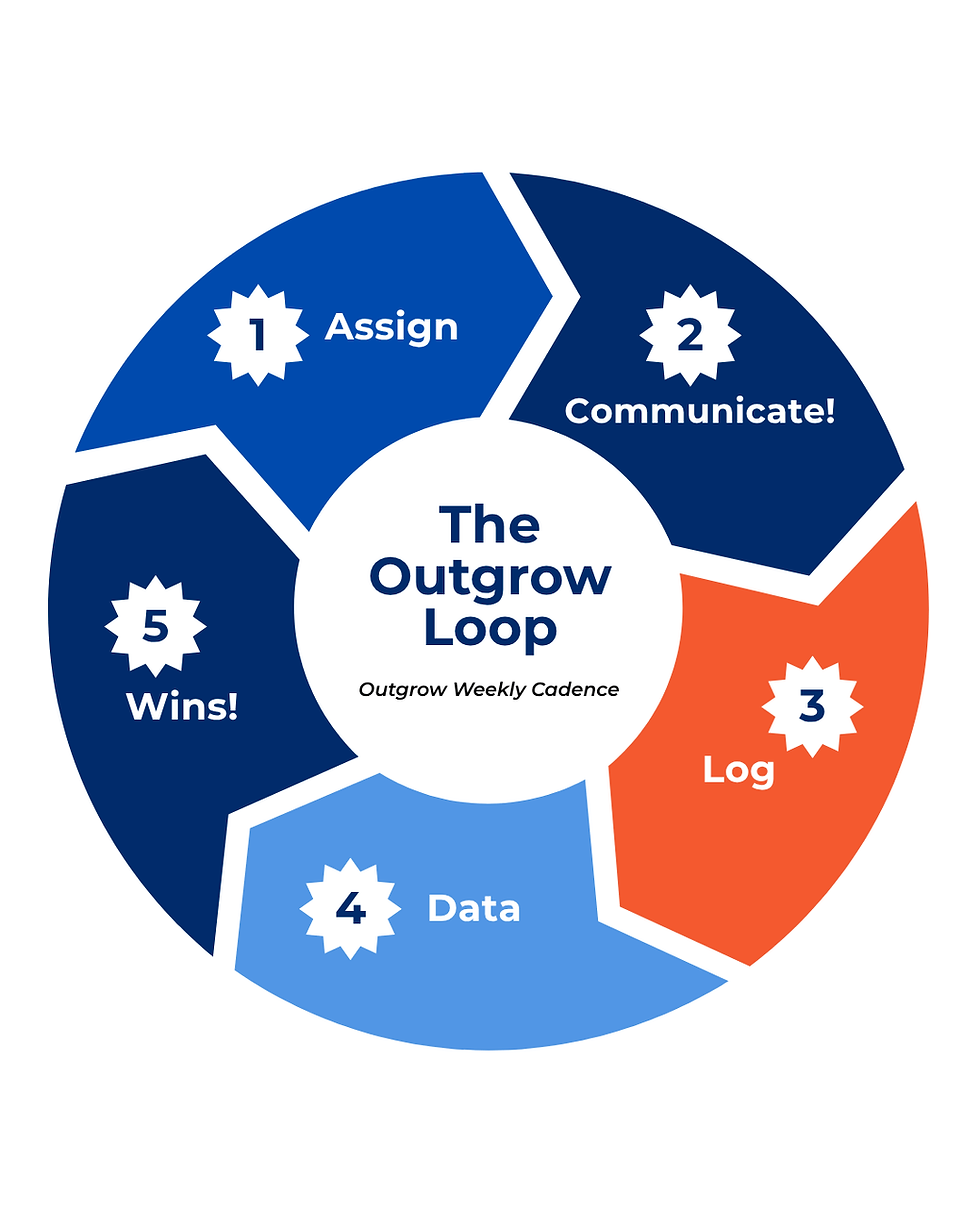
What Is Outgrow?
Outgrow is a revenue growth system developed by Alex Goldfayn and proven across more than 400 companies over 20 years. It's not a training program and it's not another initiative.
It's a simple, repeatable weekly system that transforms customer-facing teams from reactive to proactive and delivers 15 to 30% predictable annual revenue growth.
Here's what makes it different from what most companies have tried before.
Outgrow Works on Top of What You Already Have
Outgrow doesn't ask you to overhaul your processes, change your CRM, or ask your team to work harder. It identifies the revenue already in your existing customer base.
It adds a layer of simple, trackable proactive actions to what your people are already doing every day. Five minutes per person per day. That's the ask.
Your team wakes up dormant accounts.
They expand existing orders.
They stay connected with customers who haven't heard from them.
They ask for the business instead of waiting for it to come in.
And because the system tracks behaviors , not just outcomes, you get visibility into what's coming weeks before it shows up as closed revenue.
If You're Running on EOS, Outgrow Fits Right In
A lot of the leaders I work with run on the Entrepreneurial Operating System (EOS), or something close to it. They have rocks, scorecards, Level 10 meetings, a clear vision. That foundation is real, and it matters.
Outgrow is a natural complement to EOS. The proactive sales behaviors become part of your weekly cadence. The scorecards give your leadership team concrete data on revenue-driving activity. Leading indicators to bring into your quarterly conversations. Not just outcome reports after the fact.
It's Not Just for Your Sales Team

Outgrow businesses know that sales isn't a department.
Every customer-facing person in your business (account managers, project coordinators, service teams, even engineers) becomes part of the revenue picture.
One of the most compelling case studies involved an engineering firm that implemented Outgrow in only one of their three divisions of engineers.
Their engineers initially said they didn't become engineers to sell. After implementing Outgrow, that same team grew 143% in 2.5 years.
That's more than 3.75 times faster than the two divisions that didn't run Outgrow.
What changed wasn't their job. It was how they thought about the conversations they were already having. They found out they were helping their customers, not bugging them.
That mindset shift is what Outgrow does.
It doesn't turn engineers into salespeople. It turns helpful people into revenue contributors.
Adoption Sticks Because Mindset Comes First
So many sales initiatives fail not because the tactics are wrong, but because the mindset work gets skipped.
Your team knows they should follow up. They know they should check in on dormant accounts. But something holds them back. In Outgrow, this is called the default mindset. It's the belief that reaching out proactively is bothering people.
Here's how Outgrow changes the default mindset. The first part of any Outgrow implementation starts with your Outgrow advisor interviewing a selection of your best customers. They trust you. They buy from you consistently. They're happy customers.
These interviews establish the evidence that your customers actually want to hear from you. They appreciate follow-up. They wish their other vendors reached out more.
Throughout the Outgrow implementation, your teams will hear directly from your real customers, not just from leadership. This is how we change what they believe about sales.
Because behavior follows thinking. Always.
Adoption sticks because Outgrow is not another initiative that depends on willpower. It's a proactive sales system backed by belief.
Want to see exactly what an Outgrow implementation looks like?
The Outgrow Information Pack walks through the full 12-month process,
phase by phase.
How to Start Growing Revenue Again
If your revenue has plateaued, the problem isn’t effort—it’s the absence of a system.
The Outgrow sales framework is a proactive sales system built on customer lists, consistent outreach, and behavior tracking. It gives your team a clear way to:
identify opportunity
take consistent action
and predict revenue before it shows up in the numbers

You don't have to figure it out alone. I'm Betsy Richard, a Certfied Outgrow Advisor, who's spent more than 30 years in sales and business leadership.
I've seen plateaus from both sides, as the person trying to break through one and as the person helping companies do it. The leaders who come out the other side aren't the ones who pushed harder. They're the ones who changed the system.
If your revenue is steady but not growing the way it should, I'd love to have a conversation. We can look at where your team is stuck, whether Outgrow is a fit, and what it would take to build the kind of predictable growth you can actually plan around.
Start by identifying the revenue already in your customer base → customer lists that drive revenue
Then learn how to turn those opportunities into conversations → proactive sales calls
Or see how the full system works → Outgrow sales framewor
Frequently Asked Questions
Is a revenue plateau a sign that something is wrong with my team?
Not at all.
A plateau is most often a sign that the business has outgrown the approach that created its current level of success. Good teams hit plateaus. It's an inflection point, not a failure.
The question isn't what went wrong. It's what needs to evolve.
Does Outgrow work for companies already running on EOS?
It's one of the best fits there is. EOS gives you the vision, structure, and accountability framework. Outgrow gives you the systematic sales execution layer. Your Level 10 meetings become more powerful because you now have real sales behavior data — leading indicators, not just outcome reports — to work with.
The two systems complement each other directly.
How long before a company running Outgrow sees results?
It varies by sales cycle, but the pattern is consistent: when proactive actions go up, revenue follows. Some companies see results within weeks. Others see meaningful impact within two to three months. What changes immediately is visibility.
Leaders can see what the team is doing and where momentum is building before it shows up as closed revenue.
Our team doesn't have a dedicated sales force. Can Outgrow still work?
Yes. And this is one of Outgrow's strongest differentiators. The system is designed for all customer-facing people, not just salespeople. Account managers, project teams, service staff, even technical roles can all participate.
Some of the most dramatic results in Outgrow's case studies came from companies where non-sales employees became significant revenue contributors for the first time.
Betsy Richard is a Certified Outgrow Advisor and team alignment expert based in Louisiana. She specializes in helping B2B companies transform reactive sales teams into proactive revenue creators through the proven Outgrow framework combined with deep expertise in building sales confidence and overcoming adoption resistance.


Comments